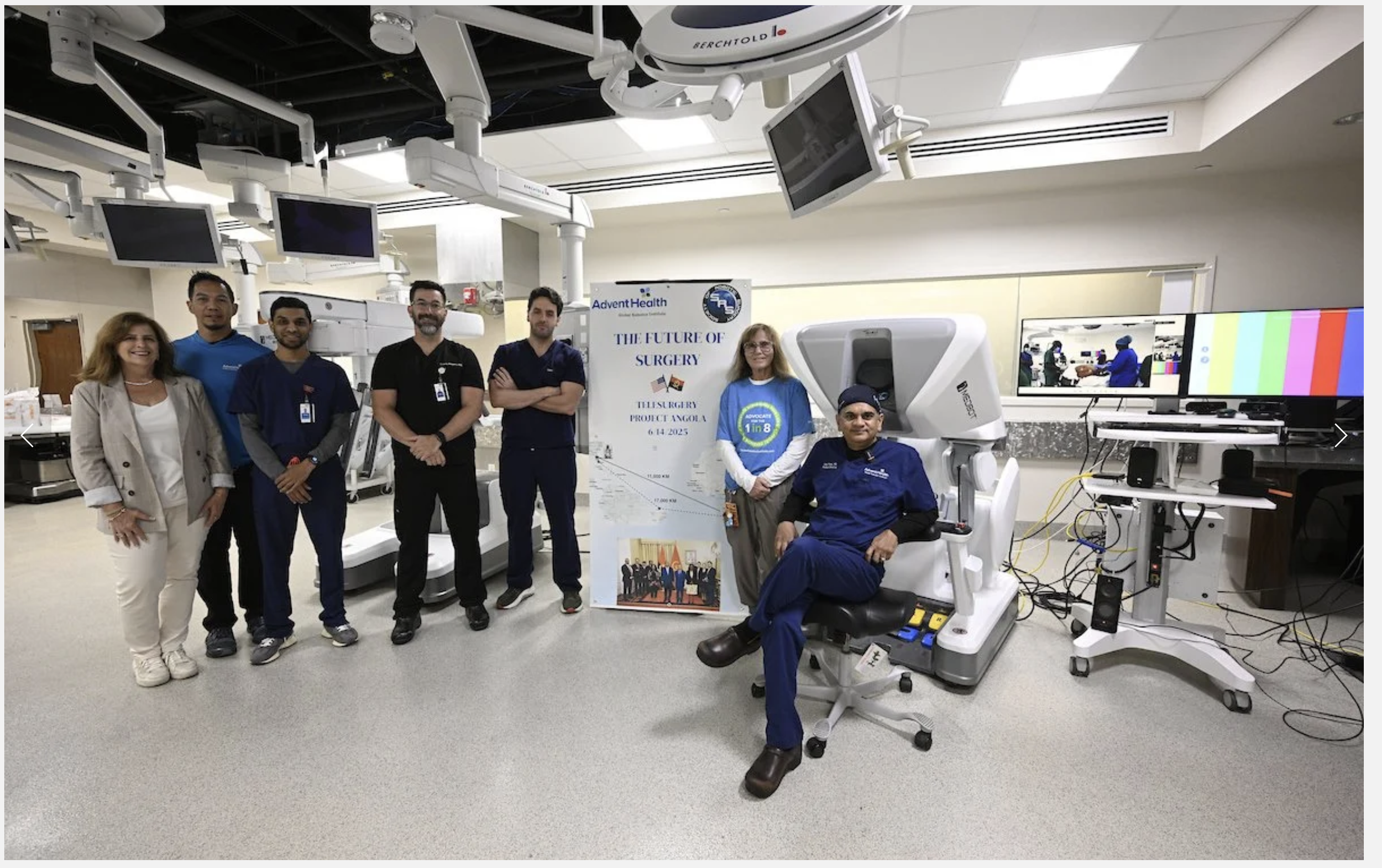
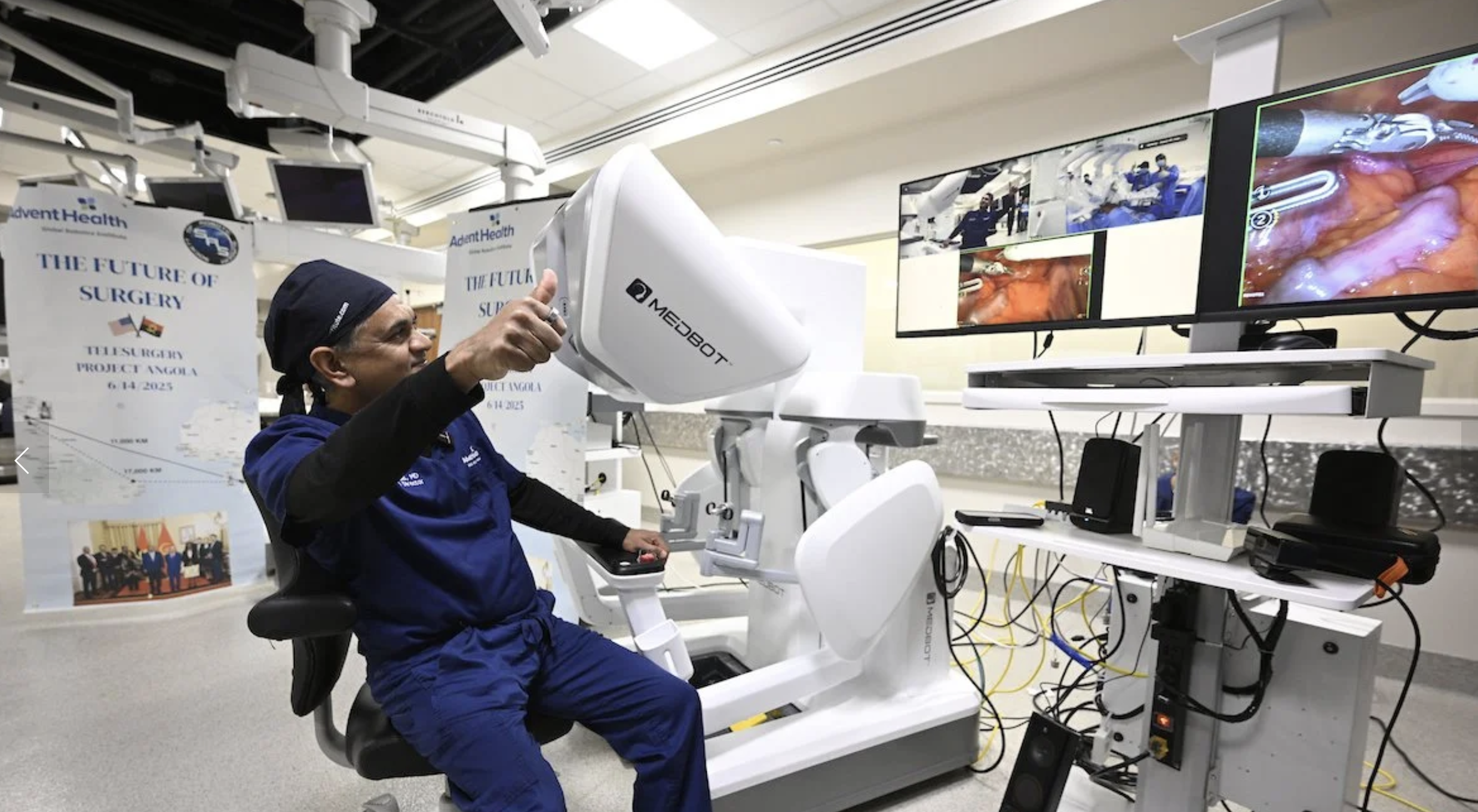
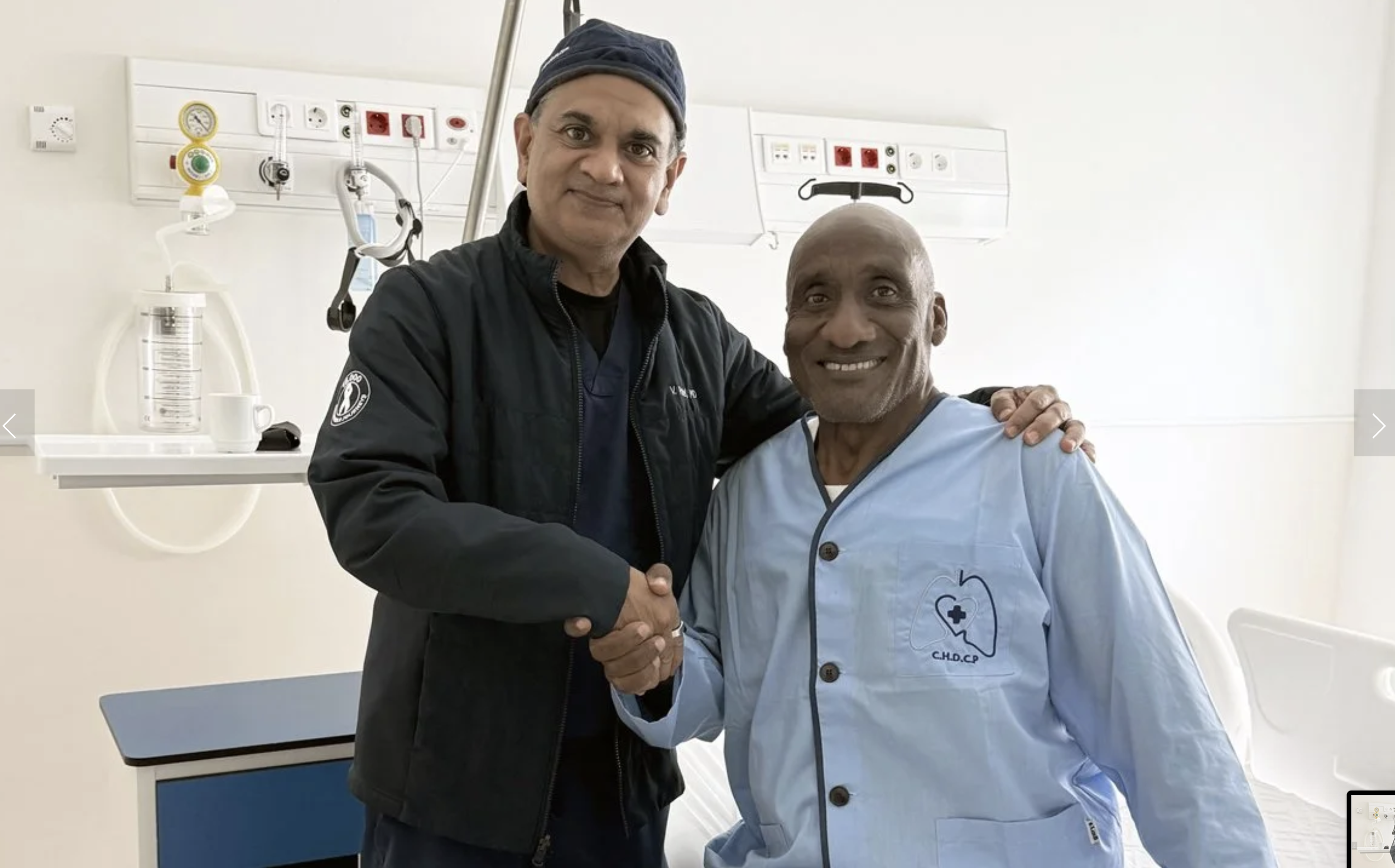
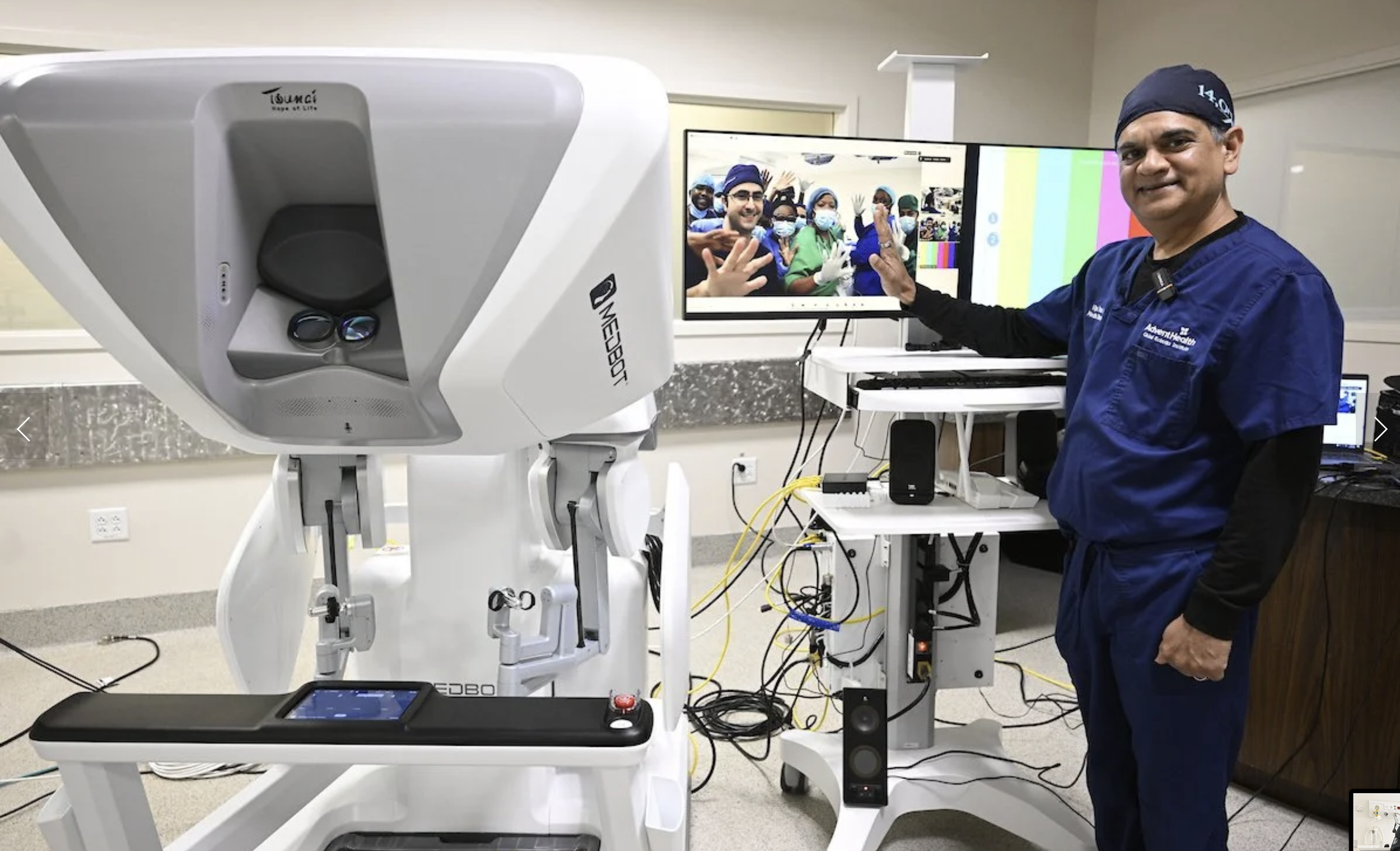
Photos by Society of Robotic Surgery
A Florida urologist removed a man’s prostate from a console in a different hospital, in what AdventHealth calls the first documented hospital-to-hospital robotic telesurgery in the United States. The robot did the reaching. The internet did the rest.
3 min read
On Sunday, October 25, a 66-year-old man named Mark lay on an operating table at AdventHealth Minneola, a community hospital in Lake County, Florida. His surgeon, Dr. Vipul Patel, was not in the room. He was not in the building. He was 35 miles down the road at AdventHealth Celebration, seated at a console, moving robotic instruments inside a patient he could see only on a screen.
Roughly an hour’s drive, if you hit the Orlando traffic wrong. Patel skipped it.
AdventHealth announced the procedure on October 26, and the claim it makes is carefully worded: published evidence, it says, has not previously documented a robotic telesurgery between two locations in the United States. Telesurgery has been tried abroad for years. This, apparently, is the first time anyone has done it from one American hospital to another and written it down.
How it worked
Patel is the founder and medical director of the Global Robotics Institute at AdventHealth Celebration, and by his hospital’s count he has performed more than 21,000 robotic prostatectomies. If anyone was going to do this one by remote control, it was going to be the man who could probably do it in his sleep. (He did not do it in his sleep. VBN checked.)
The platform was the investigational Toumai surgical system from MicroPort MedBot. Mark had prostate cancer and chose to enroll in the study. A full surgical team, led by co-investigator Dr. Marcio Moschovas, stood at the bedside in Minneola with the ability to take over at any moment. There were backup systems and contingency plans, and AdventHealth is open about why: the risks in telesurgery are not just the usual bleeding and infection but equipment failure, dropped connectivity and cybersecurity threats.
This was not a stunt. It was the U.S. phase of a research program that had already run ten investigational telesurgeries between Orlando and Luanda, Angola, about 7,000 miles apart. Thirty-five miles is, in that light, the easy part.
The fine print, which matters
The procedure was carried out under an FDA-approved Investigational Device Exemption. AdventHealth takes pains to say what that does not mean: it is not FDA approval or clearance of the system for this use, and it does not establish that the system is safe or effective. One case, the release says, is one case. It does not support broader conclusions.
Researchers are tracking surgical outcomes, network performance, cybersecurity, alarms, contingency performance and operational workflow. In plain English: did the patient do well, did the connection hold, did the alarms work, and could the humans in the room have rescued things if the machine had blinked.
Dr. Kenneth Palmer, the institute’s executive director, framed a two-Florida-hospital trial as the sensible way to examine the operational, technical and clinical questions that any U.S. telesurgery program will face. Patel, for his part, told reporters this landmark case should not end as a one-off, and that he wants to train others, expand across Florida, then the country, then beyond.
Why a culture desk cares
Here is the opinion part, clearly labeled as such.
Medicine has a geography problem. Where you live determines whether the surgeon who has done 21,000 of a given operation is down the hall or three states away. Telesurgery is a bet that expertise can travel faster than patients, and that a community hospital with a good bedside team and a solid network can borrow a world-class pair of hands for an afternoon.
That is a lovely idea, and also one with a 25-year lag. In 2001, a surgical team in New York removed a gallbladder from a patient in Strasbourg, France, in the famous Lindbergh Operation. The technology worked. What did not follow was a system willing to pay for it, regulate it and trust it. We have spent a quarter century proving the robot can do the job and almost no time building the world around it.
AdventHealth’s humility in this release is, I think, the most promising thing about it. Nobody is declaring a new era in bold type. They are saying: one patient, one study, a lot of questions still open. That is how you build trust in a machine operating from the other side of a county line.
Mark, by the way, is reported to be recovering. His surgeon never had to find parking.
References
AdventHealth. “Historic study explores whether robotic telesurgery could bring specialized surgical care closer to home.” October 26, 2026. https://www.adventhealth.com/news/historic-study-explores-whether-robotic-telesurgery-could-bring-specialized-surgical-care-closer
WFTV (Beatriz Oliveira). “AdventHealth conducts first U.S. robotic telesurgery trial.” October 26, 2026. https://www.wftv.com/news/local/an-adventhealth-surgeon-successfully-performed-remote-telesurgery-patient/YWEMVUGSJRHKFPQWISWBRX65K4/
WSVN (Alex de Armas, Isabella Fernandez de Cueto). “66-year-old man undergoes groundbreaking remote robotic surgery near Orlando.” October 28, 2026. https://wsvn.com/news/us-world/florida-man-robotic-telesurgery/
Newser (Jenn Gidman). “Surgeon Removes Prostate Using Robot 35 Miles Away.” October 28, 2026. https://www.newser.com/story/398915/surgeon-removes-prostate-using-robot-35-miles-away.html
Marescaux J, et al. “Transatlantic robot-assisted telesurgery.” Nature. 2001;413:379–380. https://www.nature.com/articles/35096636